
HSE Hearing Tests for Your Workforce
Annual audiometry that tracks changes in your employees' hearing, catching early signs of damage before it becomes permanent
It supports the employer's responsibility to provide health surveillance under Regulation 9 of the Control of Noise at Work Regulations 2005 and provides documented evidence that you're monitoring and protecting your at-risk employees.

What This Test Tells You
HSE hearing surveillance tracks changes in your employees' hearing over time, comparing annual results against their baseline audiogram to detect early signs of noise-induced damage.
For each person tested you get:
-
An audiogram showing hearing thresholds across key frequencies — the foundation for tracking any deterioration year on year
-
HSE categorisation (Categories 1–4) — a standardised assessment indicating whether hearing is acceptable, shows signs of damage, or requires medical referral
-
Comparison against baseline - highlighting any shifts that may indicate noise-induced hearing loss before it becomes severe
-
Documented evidence for Regulation 9 compliance, audit-ready records showing you're meeting your hearing health surveillance obligations under the Control of Noise at Work Regulations 2005
This turns hearing health into something you can monitor, evidence and act on, catching problems early when intervention can still make a difference.
Who This Test Is For
This test is for workers who are exposed to noise above the exposure action values set out in The Control of Noise at Work Regulations 2005.

Legal Obligation
The Control of Noise at Work Regulations 2005. Reg 9 requires employers to make hearing tests available, sets out a schedule of testing, requires that medical referrals are made where appropriate and that grouped anonymised data is collected.
We take care of that for you.

How We Differ
(In a good way)

Traditional HSE Hearing Surveillance
What the test tells you
Traditional audiometry uses a calibrated audiometer in a sound booth or quiet room to measure hearing thresholds annually. Results are categorised using the HSE scheme and compared against baseline records to identify deterioration.
How it operates on site
Testing requires a calibrated audiometer, sound booth or noise-attenuating enclosure, and a trained operator. Sessions are scheduled during day shifts, with workers attending a dedicated testing location. Equipment is typically brought to site per visit or hired.
Throughput and planning
Each test takes 10-20 minutes. Scheduling constraints, equipment setup, and operator availability limit daily capacity. Testing across night shifts or rotating patterns requires additional arrangements.
Cost considerations
Costs include equipment hire (£3,000-£15,000+), annual calibration, operator training, and per-session charges. Day rates of £1,000-£1,500 are common for on-site visits.
What you can verify
An annual audiogram compared to baseline, with HSE categorisation. Results depend on operator skill, equipment calibration, and testing environment.

Hear 4 The Long Term's HSE Hearing Surveillance
What the test tells you
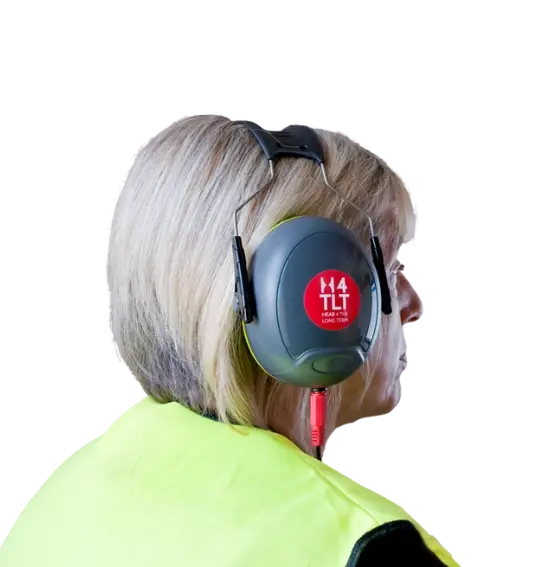
H4TLT annual hearing tests track each employee's hearing thresholds against their baseline audiogram. Using a pre-calibrated headset and secure web platform, results are recorded and reviewed by a registered audiologist to provide HSE categorisation and identify early signs of noise-induced hearing loss.
How it operates on site
The H4TLT headset is loaned directly to your site as part of the service and can be used 24/7 — no equipment hire, no separate charges. Workers complete the test through a secure web link during any shift. No trained operator, sound booth, or scheduled visit required. Testing fits around your operations, not the other way around.
Throughput and planning
Employees complete their annual hearing test when it suits your schedule — no batch scheduling, no waiting for the next available van slot, no pulling workers off the floor to meet a visiting technician. The loan period for your equipment is based on your testing volume, giving you flexibility to test at your own pace.
Cost considerations
Testing is priced per worker with volume discounts available. Equipment is loaned as part of the service at no additional cost — no day rates, no travel charges, no calibration fees, no equipment hire. You pay for tests, not logistics.
What you can verify
A documented annual audiogram for every at-risk employee, reviewed by a registered audiologist. HSE categorisation (1-4) provided for each worker. Comparison against baseline to track changes. Audit-ready health records that meet Regulation 9 requirements — protecting your workers and your business.
How It All Works
Get Started
In a quiet room connect the H4TLT headset to your computer and access the test using the secure H4TLT testing link we have provided. Each test takes approximately 15 – 20 minutes.
Test Process
The test begins with a questionnaire to establish previous noise exposure and hearing protection history together with any hearing concerns. This is followed by an intuitive pure tone hearing test.
Results
The system outputs an on-screen audiogram together with HSE categorisation for the employee which can be (optionally) emailed and highlights where a referral is required.
Referrals
Test results are reviewed and medical referrals raised where necessary
Records
Client records are provided in CSV format for short term contracts or via on-going access to the database for annual contracts. If required H4TLT will also compile the annual anonymised report.
Is your health surveillance programme meeting Regulation 9 requirements?
If workers are exposed at or above 85 dB(A), you have a legal duty to provide audiometric testing. Our compliance checker helps you assess whether your current hearing surveillance setup meets HSE expectations, and identifies any gaps before an inspector does.
Your Questions Answered
Must be kept for 40 years according to HSE guidance.
Direct answer
Health surveillance records for workplace hearing tests must be kept for 40 years according to HSE guidance. This is because Noise induced hearing loss can develop slowly, and long term records help track deterioration, support future health assessments and provide evidence if future claims arise.
Supporting detail
A health record includes the employee’s name and job role, noise exposure details, dates of hearing tests, audiometry category and actions taken or recommended,
H4TLT relevance
The H4TLT system records and stores employee details, tests, and categorisation including referrals. This can be accessed at any time by the employer, downloaded as a csv file or integrated into existing platforms as required.
Health surveillance records should include, employee’s name and job role, dates of hearing tests, audiometry category, and any actions taken or recommended.
Direct answer
HSE will need to see health surveillance records, evidence that the tests are being done properly, your noise risk assessment, your health surveillance procedure, evidence you act on the results, and information you give to employees. HSE wants to see evidence that you identify who needs hearing tests, ensure they are carried out competently, keep proper records, act on the results and control the noise risk
Supporting detail
Health surveillance records should include, employee’s name and job role, dates of hearing tests, audiometry category, and any actions taken or recommended.
To evidence that hearing tests are being done properly you will need to show that your audiometry programme is competent and compliant. Your provider will be able to help with this.
Your noise risk assessment should be current and define noise risk so you can justify which employees are included in your hearing health surveillance programme.
Your Health surveillance procedure needs to clearly show how you identify workers who need hearing tests, the testing schedule, how results are reviewed, how referrals are processed and how you act on deterioration in hearing.
Evidence you act on the results can be demonstrated with records of actions taken when deterioration is found, PPE reviews or changes, engineering or administrative noise control improvements, employee training or retraining, referrals to a doctor where required
Information provided to employees requires you to tell employees about their results and how to protect their hearing. You should be able to show copies of result letters or notifications, training records on noise and hearing protection and induction materials for new starters.
H4TLT relevance
The H4TLT system records and stores employee details, tests, and categorisation including referrals. This can be accessed at any time by the employer, downloaded as a csv file or integrated into existing platforms as required.
Are workplace hearing tests a legal requirement?
Direct answer
HSE hearing testing can be done during any shift, including nights, as long as the test equipment meets British Standards, the test is conducted to British Standards and these results are reviewed by a competent professional.
Supporting detail
The employee should be fit to be tested which means they should be awake and alert, not have been exposed to loud noise for several hours beforehand (usually 16 hours) and not be suffering from temporary ear issues (e.g., colds, earwax, infections).
H4TLT relevance
The H4TLT system enables you to test at a time and place of your choosing 24 hours a day, 7 days a week. It meets all British Standards, is UKCA and MHRA accredited and referrals are reviewed by a competent professional.
How long does an induction hearing test take?
Direct answer
An employee cannot simply refuse a hearing test when it is required under the Control of Noise at Work Regulations 2005 as once noise exposure reaches the level where health surveillance is mandatory, both of you have legal duties. You must provide hearing tests where there is a risk to health and your employee has a legal duty to cooperate. Although you cannot force them to take the test you can take reasonable management action if refusal prevents you from meeting your legal duties.
Supporting detail
Under Regulation 9, employers must provide health surveillance (including hearing tests) where noise exposure creates a risk to hearing. Once mandatory, the employer must arrange the test, keep health records and act on the results.
Your employees have a legal duty to cooperate by using hearing protection, attending training and cooperating with health surveillance.
If an employee refuses you must explain that the test is a legal requirement, document the refusal, give them the opportunity to comply and possibly escalate through your normal disciplinary or capability procedures. It is similar to refusing to wear mandatory PPE.
Even if they refuse the test, you must still protect them by providing hearing protection, enforcing its use, controlling noise exposure and keeping records of your attempts to comply with the law.
Most employers handle this by explaining the legal requirement, explaining the risk to the employee’s hearing, offering alternative appointment times, seeking support from their provider or using formal procedures as a last resort if the employee continues to refuse.
H4TLT relevance
Our questionnaire requires consent from the employee to share the data before the test can start. Less than 0.5% of employees refuse. In most instances this is a non-issue confirmed by consent.
What equipment do we need for workplace hearing tests?
Direct answer
Start with a noise risk assessment, decide who needs hearing tests, choose a provider, establish the testing schedule, create a written health surveillance procedure, set up health records, inform and train employees, act on the results and audit and review the programme.
Supporting detail
Your noise risk assessment should identify who is exposed at or above 80 dB(A), who is exposed at or above 85 dB(A), who is exposed to peak noise and which roles or tasks are therefore highest risk. This determines who must be included in health surveillance.
Hearing tests are required for anyone exposed at or above the upper exposure action value and anyone between 80–85 dB(A) who is at particular risk (e.g., early hearing changes, high risk tasks). This gives you your surveillance population.
HSE expects hearing checks to be done by a competent provider.
When selecting a provider, check audiometry qualifications, calibration of equipment, ability to classify results (Categories 1–4), referral pathways to GPs/ENT, reporting format and consider whether you want on site or self-serve solution.
Establish the Testing Schedule with your provider. Consider the logistics and cost of arranging baseline testing, annual testing, more frequent testing if deterioration occurs or a workers noise exposure becomes higher risk.
Create a written health surveillance procedure to include who is included and why, testing frequency, how results are reviewed, how referrals are handled, how you act on deterioration, how records are stored and how employees are informed. This is essential for HSE inspections.
HSE requires you to keep health records for each worker undergoing hearing checks to include name and job role, exposure details, test dates, audiometry category and actions taken.
HSE also requires you to tell employees the results of their hearing checks, explain what the results mean and provide training on noise risks and hearing protection.
Act on the results which is where many programmes fail. You must review noise controls if deterioration is found, check PPE suitability and fit, retrain workers if needed, refer to a doctor for Category 3 or 4 results and increase testing frequency if required,
An annual audit and review of the programme ensures it is legally compliant and effective. It provides evidence the right people are included, the testing frequency is appropriate, the controls are effective and whether results show trends.
H4TLT relevance.
H4TLT enables you to conduct compliant baseline testing, annual testing or fit testing 24 hours a day, 7 days a week. It is simple to use and cost effective, The system automates the process to required British Standards so no audiologist is required and each test is instantly categorised with cat 3 or 4 referrals made by a competent professional. Test records help to enable you to satisfy HSE record keeping requirements.
Baseline testing can be carried out at induction in less than ten minutes
Direct answer
Hearing tests are required for all employees exposed to excessive noise at work. You should carry out a baseline test within six months of employment, annual testing for the next two years thereafter and then every three years if the employees hearing remains stable.
Supporting detail
The baseline audiogram provides a reference point for future comparisons and the annual test data is used to identify early signs of noise induced hearing loss and measure the effectiveness of your noise control strategy. If the employee shows deterioration in hearing, they report symptoms such as tinnitus or difficulty hearing or the noise level increases and you haven’t fit tested the hearing protection then testing should be stepped up to once every six months.
H4TLT Relevance
H4TLT offers a self-service model which ensures you can comply with these requirements with the minimum of downtime and at a fraction of the cost of getting somebody in to carry out the tests. Baseline testing can be carried out at induction in less than ten minutes and annual testing can be carried out with no audiologist present whenever suits you. In addition our fit test ensures hearing protection effectiveness and may save you having to test every six months.
What happens if a new starter already has hearing damage?
Direct answer
Regulation 9 of the Control of Noise at Work Regulations 2005 sets out the legal duty for employers to provide health surveillance for employees who are exposed to significant levels of noise. It ensures that employers provide health surveillance where there is a risk to hearing, that it is appropriate to the level of risk, keep health records, act on the results, and provide employees with information
Supporting detail
Regulation 9 requires you to offer hearing checks (audiometry) to any employee who is exposed at or above the upper exposure action value (85 dB(A) daily/weekly), or exposed at the lower exposure action value (80 dB(A)) and at particular risk (e.g., already showing hearing decline, history of ear problems, or high risk tasks)
You must ensure surveillance is appropriate to the level of risk by offering baseline audiometry, regular follow up tests, additional tests if deterioration is detected and referral to a doctor when necessary. The surveillance must be reviewed by a competent person.
You must keep health records that include name and job role, noise exposure details, dates and outcomes of surveillance and actions taken. These records must be kept for 40 years.
If surveillance shows hearing damage or deterioration you must review noise risk assessments, improve noise control, review and improve hearing protection, provide additional training or instruction and consider job adjustments if necessary.
You must inform employees of their results, what they mean, any necessary follow up actions and how to protect their hearing.
H4TLT relevance
H4TLT provides British Standard compliant, UKCA registered kit which enables you to comply with Regulation 9 cost effectively and conveniently with minimum disruption to the working day.
How is an induction hearing test different from annual hearing surveillance?
Direct answer
HSE guidelines require categorisation of a workers hearing based on age and gender so that early onset noise induced hearing loss can be identified and acted upon and the overall data collected can be used to establish whether your noise control measures are working.
Supporting detail
There are four categories:
Category 2 – Warning level. Hearing is slightly worse than others of that age and gender
Category 3 – Poor hearing. Hearing is significantly worse than others of that age and gender
Category 4 – Rapid hearing loss. Hearing has deteriorated significantly since last test.
You should reinforce the benefits of regular use of correctly fitting hearing protection for Category 2 employees. Category 3 and 4 should be referred for a medical opinion. You should also review your noise exposure and hearing protection effectiveness, consider further engineering controls or job adjustments.
H4TLT relevance
H4TLT testing automatically categorises employees and raises referrals where required. The referrals are reviewed by a competent person before being passed on. The H4TLT fit test enables you to verify and record the performance of in-ear hearing protection.
How is an induction hearing test different from annual hearing surveillance?
Short answer
HSE mandated hearing tests do not always have to be done annually, but annual testing is required in certain circumstances. The frequency depends on the worker’s noise exposure and their previous audiometry results.
The HSE’s own guidance on health surveillance confirms that hearing checks must be regular, but it does not mandate a single fixed interval for all workers.
Below is the schedule most commonly followed in line with HSE expectations.
Supporting detail
HSE guidelines suggest baseline tests should be undertaken at induction followed by annual tests for the first two years. If hearing is stable then testing can be done every three years.
For Category 3 or 4 employees more frequent testing should be undertaken or where noise exposure is high or hearing protection compliance is uncertain.
HSE requires that there is a programme of regular and appropriate surveillance based on risk.
H4TLT relevance
H4TLT automatically categorises each employee ensuring testing schedules are clear and data based. In practice most of our clients test on an annual basis to keep things simple. The H4TLT fit test can validate performance of earplugs for cat 3 and cat 4 employees.
How is an induction hearing test different from annual hearing surveillance?
Direct answer
Mandatory hearing tests (audiometry) are triggered when an employee’s noise exposure reaches levels where their hearing is at risk, as defined in the Control of Noise at Work Regulations 2005.
Supporting detail
Mandatory hearing tests are required when workers are exposed at or above the Upper Exposure Action Value (85 dB(A)) or regularly or frequently exposed to peak noise at or above 137 dB(C). There are also levels of noise exposure which must not be exceeded. These exposure limit values are daily or weekly exposure of 87 dB(A) and peak sound pressure of 140 dB(C).
Even occasional exposure above 85 dB(A) or 137 dB(C) triggers mandatory surveillance if there is any concern that controls may not be effective.
Workers between the lower and upper levels (80–85 dB(A)) are also at risk.
The Noise Health Surveillance guidance also states that surveillance is required for workers exposed between the lower and upper exposure limit values if their health may be at particular risk from noise. This includes workers with early signs of hearing loss and workers with a history of ear problems.
H4TLT relevance
Use the H4TLT compliance checker to see if you need to have a noise survey carried out.
How is an induction hearing test different from annual hearing surveillance?
Direct answer
A steadily worsening audiogram is a red flag you shouldn’t ignore, and the HSE expects employers to take clear, structured action under the Control of Noise at Work Regulations 2005 to help you manage workplace risk effectively and protect your employees long term hearing. If the employee is showing deterioration year on year, that typically triggers further action.
Supporting detail
Your provider should:
Review the audiometry results properly, categorise correctly and refer for a medical opinion as appropriate. They should also advise if repeat testing is required together with a schedule.
You should:
Reassess the employee’s noise exposure in case the actual exposure is higher than expected, the hearing protection is not being used consistently or is inadequate.
Review your engineering controls (quieter tools, barriers, damping), see if it is possible to limit exposure time, validate or upgrade hearing protection or retrain the employee on correct insertion and use of hearing protection.
Keep records, document test results and actions taken including any changes to controls and follow up plans.
H4TLT relevance
The H4TLT system compares audiograms as they are carried out and automatically categorises. A competent individual raises referrals and the fit test system can be used to validate and record in ear hearing protection performance. All test results are documented and stored. These records belong to you as the Data Controller.
How is an induction hearing test different from annual hearing surveillance?
Direct answer
Category 3 means the employee’s hearing level is significantly worse than expected for their age and there is a high likelihood that the decline is related to noise exposure with the result that formal action is required. Other terms include poor hearing, abnormal hearing or significant threshold shift.
Supporting detail
HSE guidance expects employers to review the noise exposure by reassessing actual noise levels in the work area and establishing whether the hearing protection is effective. Noise engineering controls combined with job rotation and reduced exposure time should also be improved if necessary.
It is also important to ensure the employee is referred to a medical professional for an opinion as to whether the loss is noise related.
Increasing monitoring frequency to once every six months may also be necessary.
H4TLT relevance
H4TLT testing automatically categorises employees and raises referrals where required. The referrals are reviewed by a competent person before being passed on. The H4TLT fit test enables you to verify and record the performance of in-ear hearing protection.
How is an induction hearing test different from annual hearing surveillance?
Direct answer
HSE’s guidance on audiometry (L108) states that a referral to a Doctor is required when the audiometry result reaches “Referral” level (Category 3 or 4). Your provider will advise you on what to do.
Supporting detail
Category 3 employees should be referred as there hearing is “poor” when compared to others of their age and gender. This may be as a result of Noise Induced Hearing Loss.
Category 4 employees should be referred because Rapid hearing loss has been detected.
You are required to act on your providers advice promptly, review noise exposure and controls, provide appropriate hearing protection and keep clear records of results and actions.
A referral under the Noise Regulations is not a diagnosis. It is a precaution to ensure the employee receives proper clinical assessment.
H4TLT relevance
H4TLT testing automatically categorises employees and raises referrals where required. The referrals are reviewed by a competent person before being passed on. The H4TLT fit test enables you to verify and record the performance of in-ear hearing protection.
How is an induction hearing test different from annual hearing surveillance?
Direct answer
Occupational hearing loss is not normally reportable under RIDDOR so even if an employee is diagnosed with NIHL (Noise Induced Hearing Loss) you do not need to submit a RIDDOR report.
Supporting detail
Noise induced hearing loss (NIHL) is not included in the list of reportable diseases in the RIDDOR 2013 regulations.
You do still have legal duties under the Control of Noise at Work Regulations 2005 to assess noise risks, provide hearing protection, and offer health surveillance (audiometry) for exposed workers.
If hearing loss results from a single traumatic incident (e.g., explosion, gunshot, sudden acoustic shock), that may fall under injury reporting, but long term NIHL does not.
A hearing related issue might be reportable if a dangerous occurrence caused a sudden acoustic trauma (e.g., explosion) and resulted in injury or the hearing loss is part of another reportable injury (e.g., loss of consciousness, hospital treatment).
These cases are rare and depend on the circumstances.
How is an induction hearing test different from annual hearing surveillance?
Direct answer
Companies offering on site audiometry typically work on short lead times, especially when employers need to meet HSE requirements quickly. The actual time will be informed by whether they have available resource in your area, how many employees need to be tested and whether shift patterns present any problems.
H4TLT relevance
H4TLT can mobilise much faster than generalist providers since all you need is the H4TLT headset which can be couriered within 24 hours and access to the software. After a thirty minute training session you’re good to go.
How is an induction hearing test different from annual hearing surveillance?
Direct answer
When an insurer requires “HSE hearing tests,” what they’re really asking for is a compliant hearing health surveillance programme under the Control of Noise at Work Regulations 2005.
To satisfy an insurer (and HSE) simply confirm that your workers meet the legal trigger, arrange audiometry with a competent provider, set up the required documentation, act on the results and provide evidence of this process to your insurer.
Supporting detail
Insurers usually ask for hearing tests when workers are exposed to 85 dB(A) daily or weekly, 137 dB(C) peak or 80–85 dB(A) if they are at particular risk as per the thresholds used by HSE for mandatory health surveillance. If your noise risk assessment already shows exposure at these levels, you’re legally required to run hearing tests anyway — the insurer is just reinforcing it.
Arrange audiometry with a competent provider who can carry out baseline tests for all exposed workers, annual tests for the first two years, three yearly tests after that (unless deterioration is found) and more frequent tests if results show decline. This can be done using an on-site services or via the H4TLT self-serve model.
Set up the required documentation which includes a list of workers included in surveillance, dates and outcomes of hearing tests, audiometry categories (1–4), actions taken when deterioration is found and health records.
Act on the results by reviewing noise controls, checking hearing protection is adequate, retraining workers on correct use and referring to a doctor for Category 3 or 4 results. Insurers want to see that you’re not just testing — you’re managing the risk.
Provide evidence to your insurer of your noise risk assessment, a summary of your health surveillance programme, confirmation from your provider that testing is in place and proof of completed tests (not medical details — just dates and categories).
H4TLT relevance
H4TLT enables you to conduct compliant baseline testing, annual testing or fit testing 24 hours a day, 7 days a week. It is simple to use and cost effective, The system automates the process to required British Standards so no audiologist is required and each test is instantly categorised with cat 3 or 4 referrals made by a competent professional. Test records help to enable you to satisfy insurance company record keeping requirements.
How is an induction hearing test different from annual hearing surveillance?
Direct answer
A noise induced hearing loss (NIHL) claim is all about whether you, as the employer, can demonstrate that you assessed the risk, controlled it, monitored it, and kept proper records. Insurers and solicitors will expect a very specific bundle of documents. The stronger and more complete your records, the easier it is to defend the claim.
Supporting detail
You should be able to show an audit trail of noise risk assessments to include full noise surveys (with dates, methods, and measured dB(A)/dB(C) levels), maps or lists of noisy areas, identification of workers exposed above 80 dB(A) and 85 dB(A) and any updates or repeat assessments. These show whether you understood the risk and reviewed it regularly.
You should be able to show what hearing protection was issued (models, SNR ratings), when it was issued, records of fit testing, replacement logs, PPE policies and enforcement procedures and signage for hearing protection zones This demonstrates that you provided adequate protection and enforced its use.
Health surveillance (audiometry) record are sone of the most important parts of defending NIHL claims.
You will need to show baseline audiometry results, follow up tests (annual/3 yearly), audiometry categories (1–4), evidence of referral letters, evidence that employees were informed of their results and records of any action taken when deterioration was detected.
These records must be kept for 40 years as they show whether hearing loss developed during employment.
Evidence that you tried to reduce noise at source including engineering controls deployed (enclosures, damping, quieter tools), maintenance logs for machinery, job rotation or exposure time limits and procurement decisions favouring quieter equipment. This shows you followed the hierarchy of control.
You should be able to evidence you provided noise awareness training records, PPE training (how to fit and use hearing protection including fit testing), induction training, toolbox talks with signed attendance sheets. This shows the employee was informed about the risks and how to protect themselves.
You should be able to show you had policies and procedures in place including a Noise at Work policy, health surveillance procedure, PPE enforcement policy and a disciplinary procedure for non compliance. This demonstrates that you had a structured system in place.
Courts often ask whether you enforced PPE use. Useful records include supervisor logs, safety inspection records, notes of non compliance and corrective action and photographs of hearing protection zones. This can make or break a defence.
Employment records such as job description ,baseline hearing test, fit testing results work areas and tasks, shift patterns and duration of employment establish exposure history.
These records matter because NIHL claims often hinge on whether hearing loss is consistent with noise exposure, whether the you took reasonable steps to prevent it and whether you monitored hearing over time.
H4TLT relevance
H4TLT can help you to demonstrate that you assessed the risk, controlled it, monitored it, and kept proper records.