
Misguided Guidance: Where HSE’s L108 Conflicts With the Control of Noise at Work Regulations 2005

Updated: Jul 7

HSE have recently issued a prohibition notice and an improvement notice on an occupational health provider. Occupational Health overseen by an occupational health physician is the gold standard to which all employers would hold themselves in a perfect world. It is not a perfect world though, because OH resources are nowhere near sufficient to meet demand.
The DWP’s 2024 Employer Survey found that 65% of UK employers provide no access to occupational health or vocational rehabilitation services for their employees. And 99.8% of UK businesses are SMEs. This article is specifically about health surveillance relating to noise. It explores what the Regulations say, acknowledges that the supply chain is fragmented, and looks at ways to drive test numbers up in a robust way.
HSE’s own figures estimate 15,000 workers a year with hearing problems caused or made worse by work. Noise-induced hearing loss is permanent, it is preventable, and the framework for preventing it depends on employers understanding what the law actually requires of them. When the official guidance muddies that understanding, the guidance is part of the problem.
What the Control of Noise at Work Regulations 2005 actually require
The Control of Noise at Work Regulations 2005 set out an employer’s legal duties concerning noise at work. The employer, in the language of the Regulations, is the duty holder. In short, the duties are these:
Conduct a risk assessment and understand the level of noise present
Take steps to eliminate that noise, or reduce it to a safe, defined level
Provide appropriate hearing protection if noise exposure remains too great
Provide health surveillance to workers exposed to excessive noise
Provide ongoing training, information and instruction to workers
They form a sensible hierarchy: measure the problem, remove the problem, protect against what remains, watch the workforce for harm, and keep everyone informed. Our knowledge library covers each regulation in detail, including the specific exposure action values that trigger each duty.
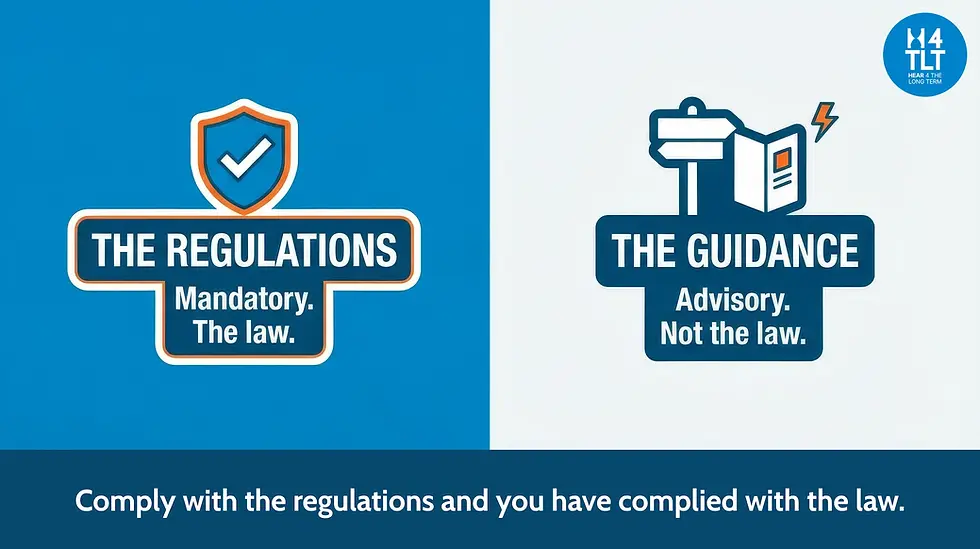
The HSE document L108 reproduces these regulations and provides additional guidance to each of the regulations. L108 serves to conflate guidance with regulations and the fact is the guidelines are neither robust nor mandatory.
Regulation 2: one regulation, two different disciplines
Regulation 2 defines health surveillance as “assessment of the state of health of an employee, as related to exposure to noise”.
There are therefore two different disciplines involved in complying with the regulation:
Competence in the assessment of the state of health of an employee. That means hearing tests.
Competence in the measurement of noise exposure and noise control. That means acoustics.
An audiologist and an acoustician are not the same profession. One assesses ears, the other assesses environments. A workable compliance strategy needs both, and understanding noise is every bit as important as understanding hearing.
It is interesting to note that noise control is defined as a component part of health surveillance. Few audiologists or OH professionals understand noise properly, and not many acoustics consultants delivering noise services have more than a rudimentary knowledge of audiology.
Yet the market, encouraged by the guidance, treats health surveillance as the product and noise competence as somebody else’s department. It should not be. When a test result and an exposure record sit side by side, each one makes the other meaningful.
It also begs the question as to who is best placed to offer hearing protection advice.
Regulation 9: the mandatory obligations, in full
Where employees are exposed at or above the upper exposure action values, or where the risk assessment indicates a risk to their health, the employer shall ensure those employees are placed under “suitable health surveillance, which shall include testing of their hearing”. The remainder of the regulation requires that:
A health record is made and maintained for every employee under surveillance, and kept available in a suitable form
Employees are allowed access to their personal health record on reasonable notice, and the enforcing authority is provided with copies of such records as it may require
Where surveillance identifies hearing damage, the employee is examined by a doctor, and if the doctor or a specialist considers the damage is likely to be the result of noise exposure, the employer must ensure a suitably qualified person informs the employee, review the risk assessment, review the control measures under regulations 6, 7 and 8, consider alternative work for the employee, and ensure continued surveillance including a review of any similarly exposed colleagues
Employees present themselves for surveillance procedures when required, during working hours and at the employer’s cost
Those, then, are the duty holder’s mandatory obligations. All of them. I have previously written about how to arrange hearing tests for employees in a way that satisfies every one of these requirements.
Notice what Regulation 9 does not say. It does not name a profession. It does not mandate a categorisation scheme. It requires suitable health surveillance, a maintained record, and a defined chain of response when damage is found.
A hearing test must be carried out by a trained operator using equipment calibrated to defined British Standards. Test results must be reviewed by somebody competent to interpret the audiogram and refer for a medical opinion. A supplier’s duty is to ensure they are competent to offer the service.
Where L108 departs from the law it is meant to explain
L108 reproduces the Regulations and then expands on them with a set of guidelines that run alongside the legal text, principally in Part 5 and Appendix 4.
None of that expansion is mandatory. Guidance is guidance.
L108 serves to conflate guidance with regulations, and the fact is that the guidelines are neither robust nor mandatory. A number of them, as evidenced below, are poorly written, badly thought out and consequently flawed.
Our knowledge library entry on the legal status of L108 explains the distinction between the regulation text, the Approved Code of Practice material and the plain guidance paragraphs. It is the guidance paragraphs this article takes issue with, and there are six areas that require scrutiny.
The implied occupational health monopoly that is not in the Regulations

Guidance paragraphs 105, 106, 107 and 108, along with paragraph 261 in Part 5, all refer to occupational health professionals keeping the medical records and offering fitness advice to work. Read those paragraphs in isolation, and you would conclude that HSE believes only OH professionals are suitable providers of health surveillance.
In fairness, paragraphs 259 and 269 of the same document refer simply to a competent adviser.
Given the lack of resource I would point out there are more than 4,400 Registered Hearing Aid Dispensers on the HCPC register.
RHAD is a legally regulated profession in the UK, governed by the Health and Care Professions Council, which sets the standards for training, professional conduct and ethics.
The Code of Practice comprises two sets of standards, one of which is for proficiency.
These are clinicians who perform audiometry to diagnostic standards every working day. For workplace screening audiometry they are, frankly, vastly overqualified.
Implying that only occupational health professionals are competent to undertake testing is inaccurate, and acts as a barrier to increasing test numbers.
Point an SME at an OH-only route, and you have built a queue for a service most of them do not have, to meet a requirement the law never imposed. Meanwhile, the testing itself is straightforward to arrange.
Anonymised records and the horse that has already bolted
Guidance paragraph 109 suggests that anonymised records can provide an insight into how well a noise control or hearing conservation programme is working.
This concept is deeply flawed. Three separate factors see to that. The level of measurement uncertainty inherent in audiometry, the time it takes for hearing loss to manifest on an audiogram, and employee churn together ensure that anonymised figures are of little value in assessing the effectiveness of a hearing conservation programme.
I have written elsewhere about why audiometric results vary between tests even in the same ear on the same day; aggregate that variability across an anonymised, changing population, and the signal you are looking for disappears into the noise, if you will forgive the expression.
And even if the anonymised data did highlight a problem, the fact is the horse would already have bolted. Hearing that has been lost to noise does not come back. You would be reading last decade’s failures in this year’s spreadsheet.
Prevention is a much better solution. Close attention to reducing noise exposure to appropriate levels, via adherence to Regulations 4, 5, 6 and 7, is a more effective strategy than post-hoc statistical archaeology on anonymised audiograms.
Appendix 4: A diagnostic standard for a screening job
Appendix 4 bases its test methodology on BS EN ISO 8253. That standard specifies methods for pure-tone air- and bone-conduction threshold audiometry.
It is, in its fuller application, a diagnostic testing framework, and Regulation 9 stipulates a hearing test. Most of 8253 is important to the robust delivery of a hearing health surveillance test, so the reference is not wrong.
The problem is what Appendix 4 fails to take from it. Health surveillance in the workplace involves testing large numbers of people, most of whom have no hearing loss and therefore no need for diagnostic testing.
Triage testing via air conduction and questions, with referral for those who may have a problem, reduces the cost burden on employers and removes an unnecessary barrier to uptake. Screen everyone, refer the few.
That is how every sensible surveillance programme in medicine works, from blood pressure checks to cervical screening. Nobody sends an entire workforce for a full diagnostic work-up to find the small minority who need one, and guidance that gestures in that direction makes compliance look more expensive and more complicated than it is.
Table 12: categories that the test cannot deliver
HSE’s categorisation scheme in Table 12 compounds the problem. Air conduction testing alone is not diagnostic.
Summing air conduction hearing levels from 1000Hz upwards cannot be used to determine acceptable hearing, mild hearing loss, significant hearing loss, noise-induced hearing loss, or rapid hearing loss, which is exactly what Table 12 purports to do with those numbers.
What air conduction testing can legitimately establish is hearing within normal limits, for the simple audiological reason that bone conduction cannot be worse than air conduction. A clear screen is a clear screen. Everything beyond that requires diagnostic testing, which is carried out by hospital audiology departments or by RHADs initiated by GPs.
A screening result dressed up as a diagnostic category is not a category. It is a guess with a table number.
The practical consequence falls on the employer. Present a duty holder with a table that claims to distinguish noise-induced loss from mild loss from rapid loss, and they will make decisions on it: referrals, job changes, and insurance disclosures.
Decisions built on a categorisation that the underlying test cannot support. The regulation asks for something honest and achievable, a competent hearing test with a proper referral route. The guidance hands out labels the data cannot carry.
Paragraph 27: unilateral is not asymmetrical
A shorter point, but a telling one. Paragraph 27 addresses unilateral hearing loss.
Unilateral loss is present where one ear is normal and the other is impaired, as identified by a diagnostic test. Paragraph 27 confuses unilateral loss with asymmetrical loss, which is a different clinical finding, and as with the other categories it is predicated on a false premise: that a screening test has told you something only a diagnostic test can.
If a first-year audiology student made this error in an exam, it would be marked wrong. It sits, uncorrected, in national guidance.
Table 13: the 23-year-old referred, the 50-year-old waved through
The classification in Table 13 is fundamentally flawed, and here the age and gender adjustments produce results that no clinician would defend.
Because of those adjustments, a middle-aged man can have a clinically moderate hearing loss and fall into category one, no action required. A woman under 24 can record thresholds which suggest no loss at all and be referred for a medical opinion as a category three.
Sit with that for a moment. The scheme waves through the man whose hearing is measurably damaged and refers the woman whose hearing is fine. A classification system that labels healthy ears as passing while passing damaged ones is not conservative or cautious. It is broken, and every referral it generates wastes a GP appointment, unnecessarily alarms an employee, and teaches the employer that hearing surveillance produces nonsense. Our knowledge library sets out the HSE categorisation scheme in full for anyone who wants to check the arithmetic.
What duty holders should take from this
The regulatory obligations fall on the employer. In order to meet those obligations, a duty holder will need to seek services from those competent to deliver them, and suppliers, in turn, have a duty to offer fit-for-purpose solutions from competent individuals.
The Regulations themselves are a perfectly workable framework: assess the noise, control it, protect against the remainder, watch your people, keep records, and respond properly when damage is found. Comply with those, and you have complied with the law, whatever route you took to get there. HSE is actively inspecting noise, and its 2025 campaign found serious gaps in how workplaces manage it, so the obligations are not theoretical.
What the guidance adds to that framework should be read critically, because, as shown above, parts of it are internally inconsistent, parts are technically incorrect, and parts erect barriers to compliance that the law itself never built.
If you want to know how your own arrangements compare with the Regulations, our compliance checker will tell you in about five minutes.
Frequently asked questions
What are the Control of Noise at Work Regulations 2005?
They are UK regulations that set out an employer’s legal duties regarding workplace noise: assess the risk; eliminate or reduce the noise; provide hearing protection where exposure remains high; provide health surveillance, including hearing tests, for exposed workers; and give workers information and training. The full text is on legislation.gov.uk.
Is HSE guidance L108 legally binding?
No. The Regulations reproduced within L108 are law. The guidance paragraphs that accompany them are not, and following a different suitable approach that meets the Regulations is full compliance.
What noise levels trigger action under the Regulations?
The lower exposure action value is a daily or weekly average exposure of 80 dB(A), where employers must provide information and make hearing protection available. The upper exposure action value is 85 dB(A), where protection becomes mandatory and health surveillance duties apply. There is also an absolute exposure limit value of 87 dB(A) taking account of hearing protection.
When are workplace hearing tests legally required?
Under Regulation 9, employees must be placed under suitable health surveillance, which shall include testing of their hearing, where they are regularly exposed above the upper exposure action values or where the risk assessment indicates a risk to their health. In practice, regular exposure at or above 85 dB(A) means hearing tests.
Who can carry out workplace hearing tests?
The Regulations do not name a profession. They require suitable health surveillance delivered competently. A hearing test must be carried out by a trained operator using equipment calibrated to defined British Standards, with results reviewed by someone competent to interpret the audiogram and refer for a medical opinion.
Do workplace hearing tests have to be done by an occupational health provider?
No. Nothing in the Control of Noise at Work Regulations 2005 requires an occupational health provider. L108’s own paragraphs 259 and 269 refer simply to a competent adviser. With 65% of UK employers reporting no access to occupational health services, an OH-only route would make compliance impossible for most businesses.
What is an RHAD and are they qualified to do workplace audiometry?
RHAD stands for Registered Hearing Aid Dispenser, a legally regulated profession governed by the Health and Care Professions Council. There are more than 4,400 on the HCPC register. RHADs perform audiometry to diagnostic standards daily, so for workplace screening audiometry they are comfortably qualified, and arguably overqualified.
What must be kept in a health record under Regulation 9?
A health record must be made and maintained for every employee under health surveillance, kept available in a suitable form. Employees are entitled to access their own record on reasonable notice, and the enforcing authority can require copies. The health record is distinct from confidential clinical notes.
What happens if a workplace hearing test finds hearing damage?
Regulation 9 sets the chain out precisely: the employee is examined by a doctor, and if the damage is considered likely to result from noise, the employer must ensure the employee is informed by a suitably qualified person, review the risk assessment and control measures, consider alternative work, and continue surveillance including a review of similarly exposed colleagues.
What are the HSE hearing categories 1 to 4?
They are a classification scheme in L108 that sorts audiometry results into acceptable hearing, mild hearing loss, poor hearing and rapid loss, using summed hearing levels with age and gender adjustments. The scheme applies diagnostic labels to screening data and its adjustments can misclassify in both directions, so its outputs should be treated with caution.
Can anonymised hearing test results show whether a hearing conservation programme works?
Not reliably. Measurement uncertainty in audiometry, the years it takes noise damage to appear on an audiogram, and staff turnover between test rounds mean anonymised aggregates carry little usable signal. By the time a trend shows, the damage is done. Monitoring noise exposure directly under Regulations 4 to 7 is the effective approach.
What is the difference between screening and diagnostic audiometry?
Screening audiometry tests air conduction to identify people who may have a hearing problem and clears those within normal limits. Diagnostic audiometry, performed by hospital audiology departments or RHADs and typically initiated through a GP, uses air and bone conduction and further tests to establish the nature and cause of a loss. Workplace surveillance is a screening exercise with a referral route.

Comments